Kappa Sigma System
v.2024-07-02
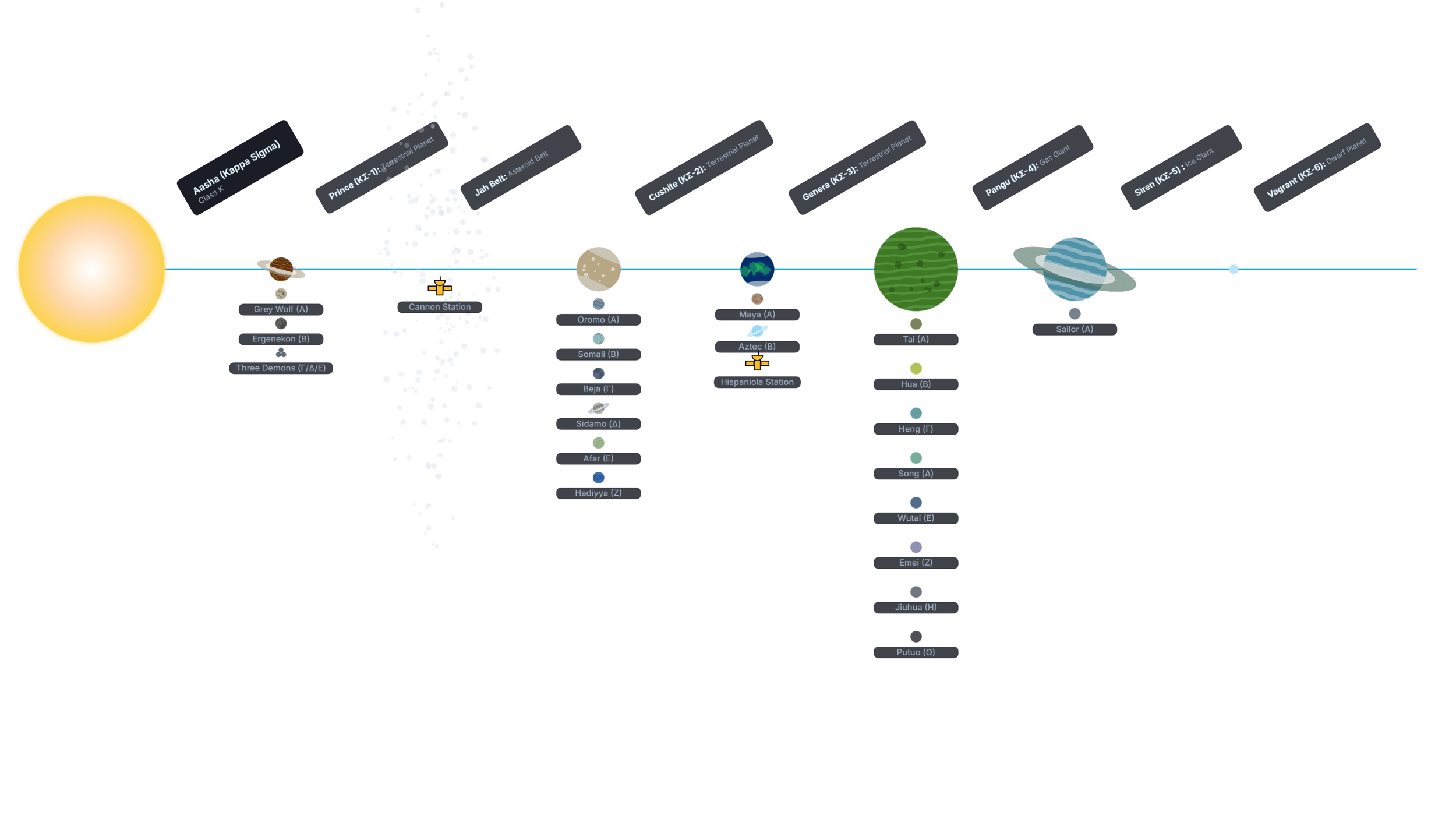
System map made using StarCar
Aasha (Kappa Sigma)
Hindi word for Hope
Prince (Kappa Sigma 1)
Names derived from Turkic mythology, Prince is little more than a sun-scorched rock covered in pyroclastic flows and wrapped in a thin but toxic atmosphere. Its rings are formed of dust captured from the Jah Belt.
Grey Wolf (Kappa Sigma 1 Alpha)
Grey Wolf is a moon not unlike Luna and spends most of its time being pummeled by asteroids. Its color comes from the iron oxide found throughout its surface.
Ergenekon (Kappa Sigma 1 Beta)
Ergenekon is Grey Wolf’s colder, deader sibling. Unlike Grey Wolf, satellite images suggest the presence of significant deposits of ice near the poles.
Three Demons (Kappa Sigma 1 Gamma / Delta / Epsilon)
Prince’s three trojans—believed to have been formed along with the Jah belt and trapped in a shared orbit with Prince.
Jah Belt
Named after Moriba Jah, this debris field is believed to have been created by collision between multiple interstellar bodies, resulting in the formation of Prince, the Three Demons, and Prince’s moons. Debris which escaped Prince’s gravity formed the belt that exists today. Scientists believe the Jah Belt will form into a new planet within the next few million years.
Cannon Station
Named after Annie Jump Cannon, Cannon Station is the last true refuge before traversing the Jah Belt. It was originally set up to act as a research and resupply base for expeditions into the Jah Belt. Today, those research operations have largely been replaced with others focused on mining, shipping, and black market activity. Still, some scientific minds have chosen to make their names on the hectic station.
Cushite (Kappa Sigma 2)
Named for the Cushitic region and its languages. Cushite is a barren world with little remaining atmosphere. The planet has vast ice caps and glaciers formed of both water and carbon dioxide ice. The ammonia- and sulfur- based atmosphere diminishes its value, as do the constant surface winds in the hundreds of miles per hour.
Oromo (Kappa Sigma 2 Alpha)
Somali (Kappa Sigma 2 Beta)
Beja (Kappa Sigma 2 Gamma)
Sidamo (Kappa Sigma 2 Delta)
Afar (Kappa Sigma 2 Epsilon)
Hadiyya (Kappa Sigma 2 Zeta)
Genera (Kappa Sigma 3)
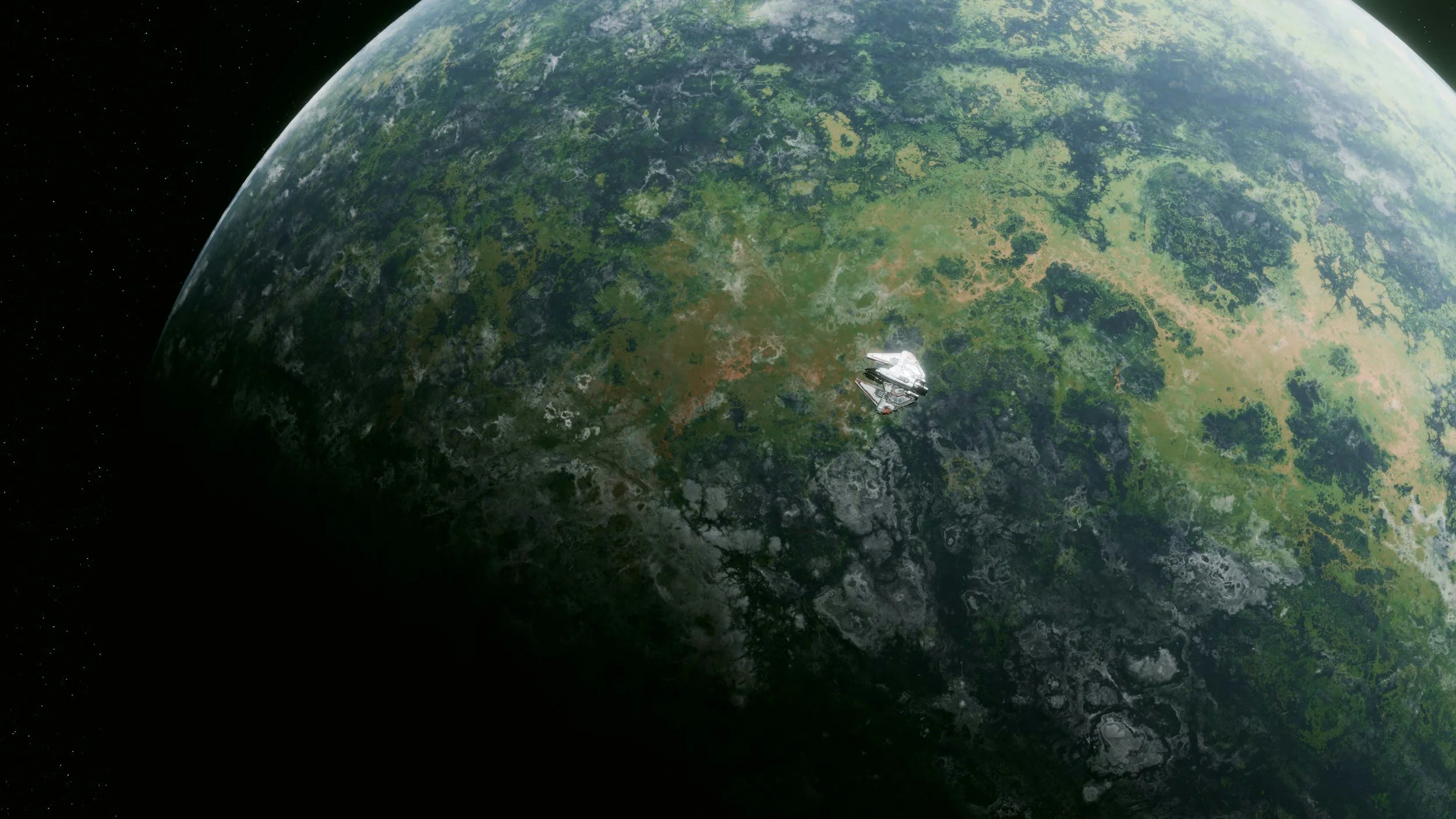
Named as a play on “Genesis”, Genera was the Kappa Development Group’s first and largest investment into terraforming. Decades later, though the biosphere is incomplete and the climate still unpredictable, this garden world is one of the most populated planets in the explored galaxy. Its moons are named after Mesoamerican civilizations.
Maya (Kappa Sigma 3 Alpha)
This iron-rich moon of Genera frequently appears orange in the night sky. Although home to many outposts, Maya is not suitable for settlement as it lacks more than a trace atmosphere.
Aztec (Kappa Sigma 3 Beta)
Aztec is essentially a massive ball of ice. Rather than typical continents, the “continents” on Aztec are but vast glaciers floating on a deeply-buried sludge of water compressed by pressure mixed with silica. Tectonics between these glaciers have produced a landscape of ice and trapped silica dust. The rings of Aztec are believed to have been created when a comet passed near the moon and the ice of its tail was captured in orbit. When the light is right, this captured dust appears as light blue rings around the frozen moon.
Hispaniola Station
Originally built to act as a logistics hub for Kappa Development Groups automated terraforming supply fleets, the scale of this derelict space station is almost difficult to imagine. Although it orbits Genera further than either of its moons, the station is visible on a clear night with some magnification. The vast orbital complex stretches tens of miles across in all dimensions and is a seemingly endless array of frameworks, pipes, conveyor ducts, and machinery. The station has long since been looted of most if its value, leaving a gargantuan husk floating in space. Still, populations of scrappers, looters, engineers, and others have use for the station and reside in pockets throughout its hulking mass.
Pangu (Kappa Sigma 4)
Named for the Taoist faith’s first sentient being and creator, Pangu appears to play a valuable role protecting the planets of the Kappa Sigma system by attracting extrastellar threats in its powerful gravitational pull—similar to Jupiter in the Sol system. Pangu’s moons are named after sacred mountains in China in a symbolic representation of Pangu’s creations.
Tai (Kappa Sigma 4 Alpha)
Hua (Kappa Sigma 4 Beta)
Heng (Kappa Sigma 4 Gamma)
Song (Kappa Sigma 4 Delta)
Wutai (Kappa Sigma 4 Epsilon)
Emei (Kappa Sigma 4 Zeta)
Jiuhua (Kappa Sigma 4 Eta)
Putuo (Kappa Sigma 4 Theta)
Siren (Kappa Sigma 5)
Named for the attention the planet drew on sensors due to its unusual electromagnetic interactions with its moon—as well as the subsequent disappointment of finding the world was an uninhabitable ice giant—Siren looms on the edge of the Kappa Sigma system like a jewel. The planet has only one moon, Sailor, named for its literary relation to mythological Sirens and for its close orbit to Siren.
Sailor (Kappa Sigma 5 Alpha)
Sailor contains significant amounts of iron, cobalt, and nickel. Additionally, it orbits unusually close to the planet of Siren. So close, in fact, that the rotation of the moon interacts with Siren to create a dynamo effect. As such, the two celestial bodies create unusually powerful magnetic fields together. Scientists note that Sailor’s orbit is degrading and it will likely collide with Siren within the next few millennia.
The powerful magnetic fields and necessity to stray so close to Siren make this moon difficult to access—much to the chagrin of those who would seek to mine its plentiful resources.
Vagrant (Kappa Sigma 6)
Vagrant’s name is best understood by its contested classification. The celestial body is called a dwarf planet, a moon, and a comet all at once. Regardless, Vagrant was captured in Aasha’s orbit relatively recently—perhaps only a few millennia ago—and remains there to this day. The small world has a highly elliptical off-axis orbit, making it difficult to travel to. Still, travelers make the journey—usually in hopes of mining some of the methane ice which comprises over 10% of the world’s mass. Although harsh and difficult to reach, colonies persist below the surface of the harsh world.